
The Future of EV Charging: How DC-Coupled Charging Technology is Changing the Game
As more homeowners invest in solar energy and electric vehicles, a new question is starting to surface: how do you connect the two in the most efficient way possible?
Traditional EV charging solutions get the job done, but they were not designed with solar in mind. A newer technology, known as a DC-coupled EV charging module, is changing that by creating a direct link between your solar system, battery storage, and your vehicle.
What Is a DC-Coupled EV Charging Module?
At its core, this technology is a bridge between your home’s energy system and your electric vehicle. Most homes and most EV chargers operate on alternating current (AC). But both solar panels and EV batteries naturally operate on direct current (DC). That mismatch creates inefficiencies, because energy has to be converted multiple times before it reaches your car. A DC-coupled charging system eliminates that extra step.
Instead of converting solar energy from DC to AC and then back to DC again inside your vehicle, this system allows electricity to flow directly from your solar panels or battery storage to your EV in DC form.
How It Works
Think of your home energy system as three main components:
Solar panels generating DC electricity
A battery storing that DC energy
Your EV, which also runs on DC power
A DC-coupled charging module connects all three on the same electrical pathway.
Here is what happens:
Your solar panels produce energy during the day
That energy flows directly into your home battery or charging system
When you plug in your EV, the system sends DC power straight to the vehicle
Smart controls decide whether to pull energy from solar, battery storage, or the grid if needed
Because the system avoids unnecessary conversions, it reduces energy loss and increases overall efficiency.
Curious how this would integrate with your solar system?
Will This Work With Every EV?
While DC-coupled EV charging is a major step forward, it is important to understand that it is not universally compatible with every electric vehicle.
Most EVs can still charge when connected to a compatible system, but the level of functionality can vary depending on the vehicle.
Here are the key factors that determine compatibility:
Charging standards and connectors
Vehicle software and manufacturer support
Bi-directional capability for features like home backup or energy sharing
What this means for homeowners is simple:
Most EVs will charge without issue
Advanced features depend on your specific vehicle
Compatibility is expanding as manufacturers continue to adopt these technologies
Since there is no universal compatibility checker for EVs and energy storage systems, the best reference point is the battery manufacturer's tested compatibility list. This is generally the closest thing to an official guide and reflects the vehicles the manufacturer has evaluated with its equipment.
Compatibility lists are typically updated as additional vehicles are tested and may include information related to charging functionality, communication protocols, and in some cases vehicle-to-home (V2H) or vehicle-to-grid (V2G) capabilities.
Because vehicle firmware, charging standards, and manufacturer support can change over time, we recommend reviewing the latest compatibility information directly from the battery manufacturer before making a purchasing decision.
You can view Sigenergy's current compatibility list here: https://www.sigenergy.com/en/index/v2x_compatibility
This list is continuously updated as more EV models are tested and approved, and it currently includes vehicles such as the Hyundai Ioniq 5, Kia EV6, Tesla Model Y, Porsche Taycan, and others.
The most effective approach is to look at your specific EV and how you want to use it within your home energy system so you can understand the level of integration that is realistically possible.
Faster, Smarter Charging at Home
Another major advantage is speed.
Since the charger is delivering power directly to the vehicle battery instead of relying on the car’s onboard converter, it can support higher charging rates similar to commercial fast chargers in a residential setting.
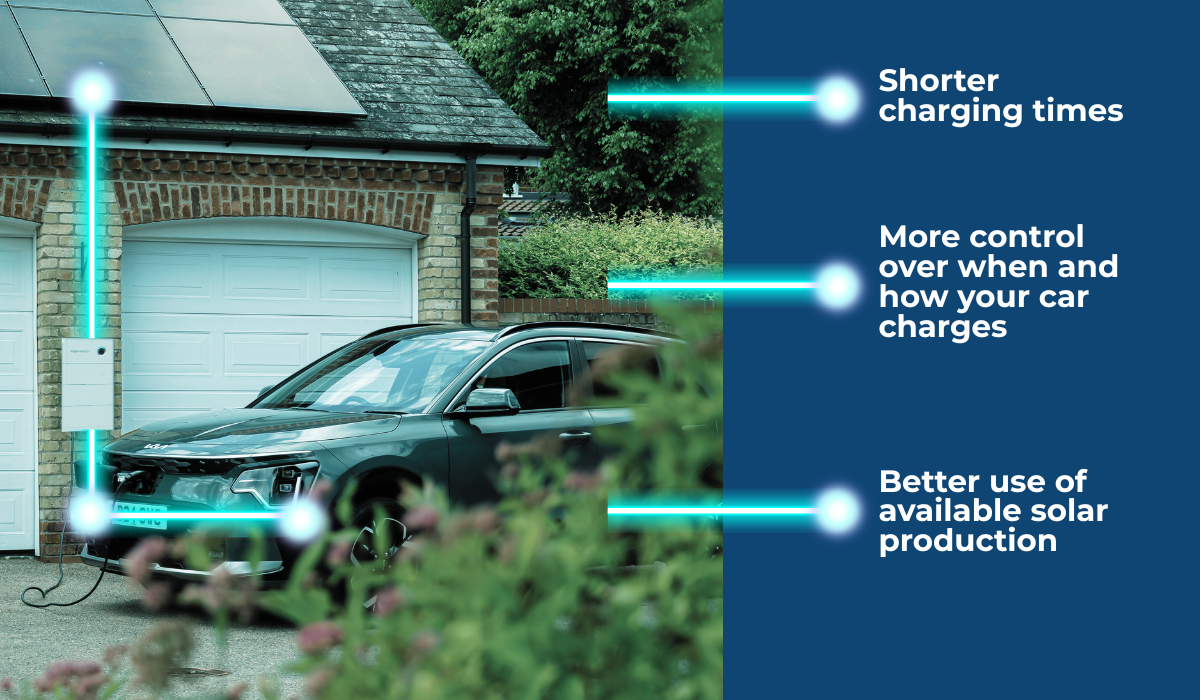
This means:
Shorter charging times
More control over when and how your car charges
Better use of available solar production
Ready to upgrade your home charging experience? Let’s build a faster, smarter solution for you.
Turning Your EV Into Part of Your Energy System
This technology does more than charge your car. It transforms it into an active part of your home energy system.
With bi-directional capability, often referred to as vehicle-to-home or vehicle-to-grid, your EV can:
Power your home during an outage
Store excess solar energy for later use
Send energy back to the grid during peak demand
Your vehicle becomes more than transportation. It becomes a mobile energy storage system.
Interested in backup power solutions that go beyond batteries? Ask us about EV integration options.
Why This Matters for Solar Homeowners
If you already have solar or are considering it, this type of charging unlocks significantly more value from your system.
Here is why:
Maximize your solar investment
Use more of the energy you produce instead of sending it back to the grid.Reduce energy losses
Fewer conversions mean more usable energy.Lower charging costs
Charging from your own solar production can significantly reduce fuel costs.Increase energy independence
With storage and EV integration, you rely less on the grid.Future-proof your home
As EV adoption grows, integrated systems are designed to adapt.
Not sure if your system is optimized? Book a system performance review today.
A Smarter Way to Power Your Life
The shift toward electrification is not just about switching to solar or driving an EV. It is about connecting everything together in a smarter way.
DC-coupled EV charging represents the next step in that evolution. By aligning how energy is generated, stored, and used, it creates a more efficient, resilient, and sustainable home energy system.
For solar homeowners, it is not just an upgrade. It is a smarter way to power your home, your vehicle, and your future.Ready to take control of your energy? Get in touch today to explore your solar, storage, and EV charging options.
Proudly serving communities across Northern California and beyond, we’re here to help you with all your renewable energy needs. Our service areas include Grass Valley, CA, Auburn, CA, Loomis, CA, Granite Bay, CA, Lincoln, CA, Rocklin, CA, Roseville, CA, Cameron Park, CA, Diamond Springs, CA, Placerville, CA, Pollock Pines, CA, El Dorado Hills, CA, Truckee, CA, Tahoe City, CA, and South Lake Tahoe, CA. Contact us today to learn more about our residential solar solutions, such as a solar powered system, backup batteries/battery storage, smart energy management, home standby generators, electrical vehicle chargers, and solar system servicing (system check & repair) available in your community.